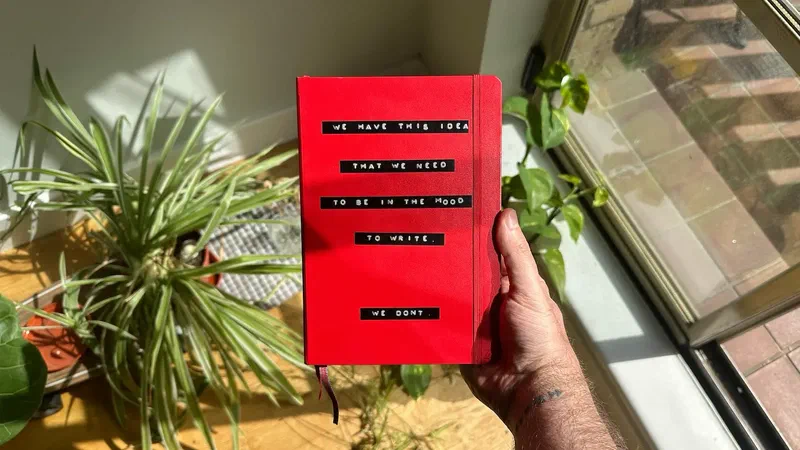
When I started this blog, I wanted to use it to document my creative process.
I think I’m a stuck creative. For the past couple years, I’ve been writing as a way to get unstuck. I’ve done many different things in the past 10 years, from releasing music on Spotify, to daily travel vlogs, to documentary-style videos, to covering the NAMM show in California, to having my weekly YouTube video series, to writing here.
And I have been writing about habits, practices and tools I use. Like using a timer, or writing on paper with a fountain pen, or separating drafting from editing.
But I realised I haven’t really talked about how I write my blog posts. So here’s a somewhat ordered list of what happens:
Before drafting
At this stage, I haven’t decided to write about anything specific. I’m just going about my life, and ideas find me. I have space in my creative process for what to do when that happens:
- I take notes on notecards (I get ideas while journaling, or while doing something else). Quotes, questions, phrases I want to remember or explore.
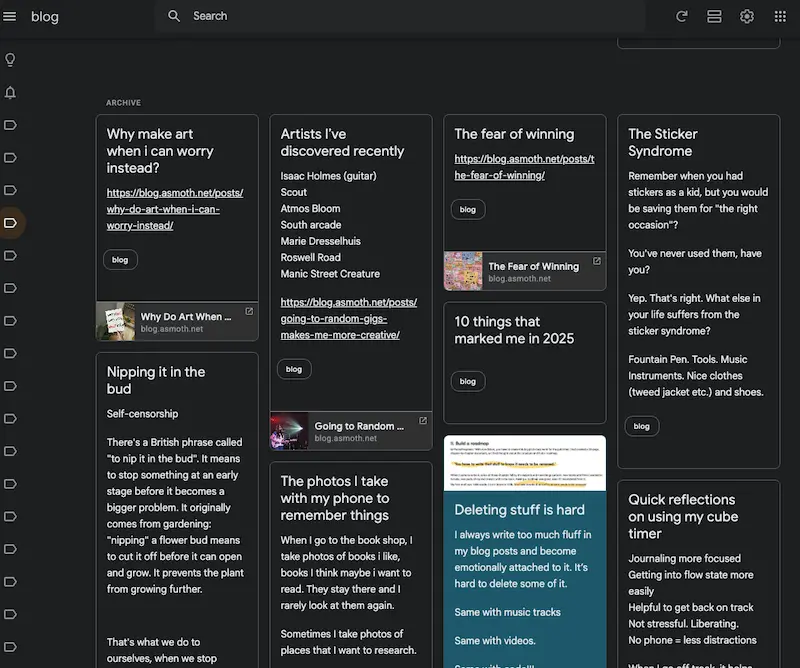
- I take notes about what blog posts to write and themes on Google Keep. They are like a wall of sticky notes with ideas of blog posts I can pick from when I sit down to write.
Drafting
At this stage, I’ve decided I was going to sit down and write. Sometimes, there’s a topic I want to write about (from my list, or the notecards mentioned above). Sometimes I don’t have a topic, or I can’t choose, and I decide to get started anyway.
- I set a timer for 30 minutes.
- I write in my notebook, with a fountain pen. Usually a Pelikan M400 Souveran.
- I write. Or I do nothing. Those are my only two options.
- I keep writing until the timer goes off.
- Once the timer goes off, I set it for another 30 minutes (if I have time).
- Days later, I re-read the draft. I think about it. Maybe I decide on a theme.
- I do another drafting session (and repeat the few bullets above).
Editing
At this stage, I have at least one draft in my notebook about a topic that I think will be a blog post. Often I have written two or three variations on that theme, from different angles. I then set aside some time to go from draft to edit.
- Days later, I type the draft on my computer. If there are two different drafts, I choose the one I like the most, or I combine what I like from each into something new.
- I take a break, then I do a first edit. I go through it paragraph by paragraph, and I change stuff, I remove what I don’t like, I clarify what is not clear.
- I get stuck.
- A day or two later, I do another edit session. I read the post from scratch again, sometimes adding some edits as I go along, sometimes jumping straight to a section that is giving me a hard time.
- I get stuck again (this happens a lot).
- I often end up removing a lot of stuff, where I’ve repeated myself, or where I feel I’m trying to say too much in one post.
- Sometimes, I will use Gemini1 to analyse the post and give me feedback. Are there themes? Things I repeat a lot? Things that are not super clear? Things that are a bit too long? I do not let it suggest rewrites. Instead I get it to ask me questions. I don’t really have anyone to chat with about that stuff, so this is sometimes useful.
- Then I keep editing.
Publishing
At this stage I am happy enough with my edit, and I have decided I was going to publish it. There is a number of tasks I need to do then, like picking a good title and description, a thumbnail, and posting it on social media. I do NOT like that stage!
- Then (and this is the hardest part) I look for ideas for a thumbnail. I struggle a lot with this. It has to fit the theme, look good, and be the right format for the website.
- Then I spend some time going through my camera roll on my phone to find something that could be a thumbnail. Or I take a new photo.
- Then I realise that I took yet another flat-lay photo of my desk, notebook, fountain pen. I go back to finding a different thumbnail idea and taking photos!
- I publish the post.
- I post a story on Instagram with a link to the post. Maybe I will post something on Threads.net as well.
- I send the post to some people I know, directly. I just like sharing that I finished something, it gives me energy. It’s like sharing something that makes you happy with the people around you!
Finding My Voice
What makes a post sound like me?
Every post I write is rooted in one question: What does it actually feel like?
What does it feel like, to be stuck? To use a fountain pen instead of a keyboard? To set a timer for 30 minutes and just write? This is what I think people will relate to.
When trying to access those emotions, I don’t always find the ones I was looking for. I sometimes get poisoned by doubts like “Is it good enough?” and “Who do you think you are?”. But it’s important that I keep searching for “what it feels like”, because I don’t want to write something that looks like a reference manual, or a lecture.
What I want is for someone to read it and think “OMG, me too!”, and leave with something useful. I want them to feel inspired and hopeful. I want to help.
I think adding that emotional bit is what takes it from just a checklist to something that feels real.
How Do I Finish?
At the end of the day, it really is down to two things. It’s about (1) habits and (2) knowing when to stop.
After a while, I reach a point where I start doubting everything. The whole post looks bad. Anything I change seems to make it worse.
That’s when I stop. That’s when I know I have to move on. I’m not having fun anymore. I just want to do something else.
In those moments, here’s what I tell myself: Allow yourself to stop. Be kind to yourself. You do not need to shame yourself. There will be other posts, don’t worry. You get better by moving on and doing new stuff, not by staying stuck on the same piece. Focus on quantity. Keep making things.
If I stay stuck on the same piece, I build up frustration. I get bored and annoyed, or scared and stressed. So I allow myself to move on, and start something new.
Creating is just like a tunnel. The only way is through. I can’t stop inside, or I’ll stay stuck in the dark. I have to keep moving. Then once I’m out, I take the tunnel again! It’s a process, and going through the process is what makes me better. And it’s fun.
Conclusion
So, that’s my writing process, as of July 2026. It might be different from yours, and that’s okay! I like documenting those things. It will be interesting to look back, in a couple years time, to see what’s changed.
Okay, now, I have to find a good title and a thumbnail… :)
-
I realise this may be controversial, especially at a time where many artists worry about how AI will affect them. I’ve debated with myself whether I should avoid talking about it. But I wanted to be honest: sometimes I need someone to help me take a step back, and in the absence of a someone, this tool is helpful. I’ve actually noticed that recently I’ve become more comfortable at pattern-matching when re-reading myself, so I feel I am improving and needing this tool less. ↩︎